Wanderlust
Apr 23, 2020
Earth Day: Three Epiphanies Underneath a Cherry Tree
Written by
Don George
In the past few weeks, I have written about making my ASAP List of places I want to go as soon as we’re able to wander the world again, without waiting for an uncertain Someday. I have also written about the surprising truth that some places are getting booked up for 2021, so you may even want to book your ASAP travels now. This week I want to share a much more personal tale, but one that I hope will resonate with you, too.
Over the last few days, I had been thinking how easy it is to have our visions narrowed and our dreams dulled, how easy it is to feel stuck, lose energy, bemoan the state of the world, and mourn the losses all around. It is easy and of course, sometimes it is appropriate, too. It is honest and healthy to acknowledge and embrace the daily difficulties we face. But it is not healthy to lose hope or to let our dreams perpetually deflate. I learned this all over again on Earth Day, in a most unexpected way.
The day was beautiful, temperature in the 70s, with a deep blue sky and white, puffy, cotton-ball clouds. In a normal year, I wrote in my journal, I would be exultant about all this. I’d be exclaiming at the blossoms, writing poems to the petals, drinking toasts to the budding boughs. But of course, this is not a normal year. I spend most of my hours inside. I scrupulously wipe off every package that arrives at my doorstep. I wash my hands 20 times a day. And when I do go outside, I put on a mask, and meet passersby with a wary eye.
I put down my pen and looked at the calendar: Earth Day. Suddenly our earthly home seemed so intimately interconnected and so fragile, so vulnerable, at the same time. I pictured our great green and blue sphere in my mind. Last year, I wrote, I was in Japan at this time—and then a wave of nostalgia washed over me. I miss Japan, I realized, staring at the white walls in my room. I especially miss spring in Japan, when the cherry blossoms bloom.
In that moment, a mini-quest was born: to find a cherry-blossom view.
I began by exploring my neighborhood. Neighbors’ gardens abounded with orange poppies and red geraniums, white saxifrage and yellow daffodils, golden freesia and purple waterfalls of wisteria. But no cherry blooms.
I ventured to the nearby cemetery, where a line of cherry trees ascends to the top of a rise. But these trees had already shed their blooms; there were no pink-and-white petals to spy. I remembered two glorious trees on a nearby hillside. I found the hill and the trees, but they were ablaze with burgundy leaves.
No cherry blossoms for me this spring, I thought with a sigh.
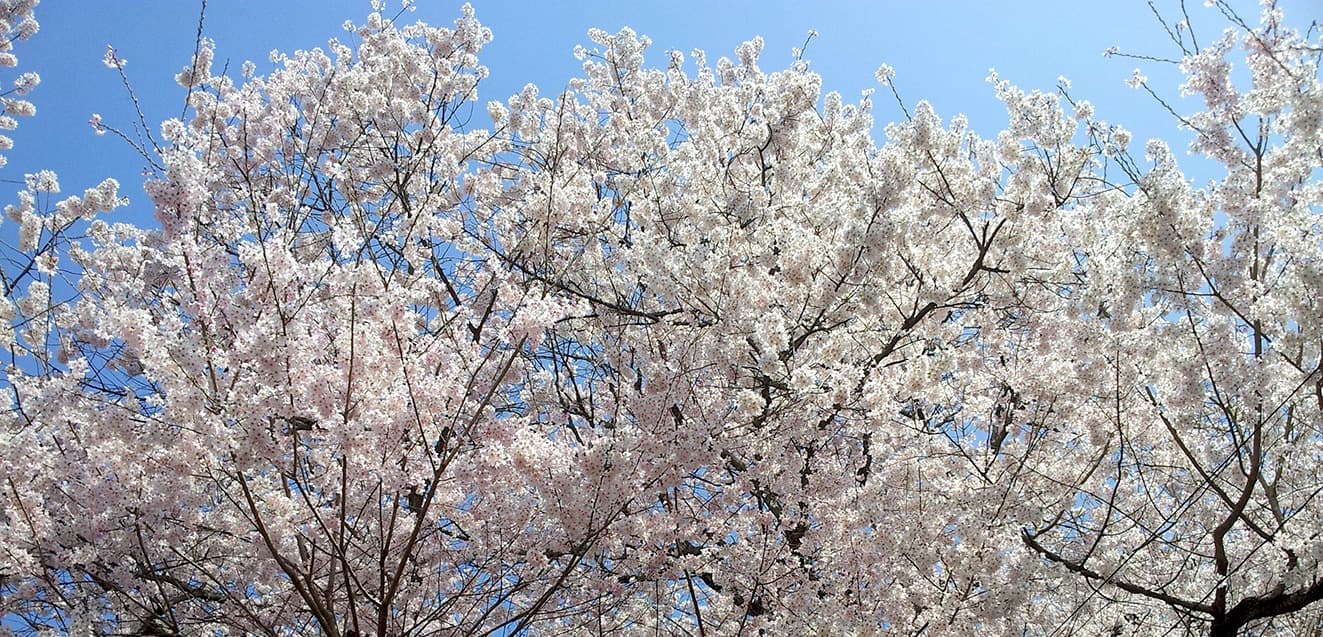
Then, I’m still not sure why, something prompted me to walk to the town park, about fifteen minutes away. When I crested the hill that leads to the park, I could hardly believe my eyes: There, right at the edge of the green, were two cherry trees still in brilliant bloom! As I approached, I could see that they were someiyoshino, the beloved trees that burst into fragile, fleecy clouds throughout Japan every spring.
And then I thought: This calls for an ohanami. The ohanami is a cherry-blossom-viewing party, and it’s one of my favorite Japanese rites. When the blossoms bloom, Japanese society comes to a stop, and all the citizenry take to the parks. They spread great squares of blue tarps under the trees, arrange their shoes in neat rows on the grass, bring out bento boxes bearing special treats, like sushi, rice balls, tempura’d eggs, and chicken karaage, and then, of course, big bottles of beer and sake. They feast and drink, talk and laugh, dance and sing under the boughs—presidents and plumbers, students and salesclerks, housewives and models and grandmas. When the cherry trees bloom, the Japanese do too.
So I had to have an ohanami. I jogged home, carefully backpacked a bottle of sake that I had been saving for a special occasion, and a beautiful blue and white ceramic sake cup from Arita that had been given to us as a wedding present. I returned to the park, positioned myself under a petaled branch, discreetly opened the bottle, and filled my cup with the sacred brew.
I raised a toast to the boughs above and suddenly it struck me: This patch of pink-and-white blooms against the deep blue sky looked exactly the same as the patch I’d seen a year before on a bridge overlooking the canal that runs by the Philosopher’s Path in Kyoto. Exactly.
I remembered the precise spot where I had been standing, in the middle of the bridge with the sunlight glinting off the canal. I remembered the blossoming branches that had arced over the water on both sides, the breeze that had stirred the boughs, and the faint perfume of the petals that had descended from the sky. A young woman in a white blouse and pink vest smiled behind a street cart selling cherry blossom gelato, and a path-side coffeeshop advertised cherry blossom cheesecake. A trio of schoolgirls in pink and blue kimonos giggled by. And all along the path, dozens of walkers from at least a dozen countries oohed and aahed at the blooms, and Instagram addicts preened as they waited in a queue.
Teenage boys in black and white school uniforms sped by on bikes, past a trio of tourists in shiny rental kimonos laughing as they awkwardly clip-clopped on geta clogs. An artist sat before an easel on the bridge to my right, intent on capturing the play of blue-gray-pink light. The plangent notes of a shamisen wafted from behind a shoji screen, and a gusty breeze conjured a scene of twirling, caressing pink flakes.
I drained my cup and once again, the pink flakes gentled my face, and I considered why the Japanese prize such a poignant place. Ethereal and sensual at the same time, these blossoms bring delight to everyone’s hearts and minds. They bloom for a week, or two, and in that short space, bestow a lasting and transforming grace. Then a wind rises, and they soar off their boughs, twirl and twirl and twirl to the ground.
The flowers are feted for their beauty and brevity, which symbolize the impermanence of everything. Their exquisite beauty is fleeting, and this gives their efflorescence an evanescent, eternal meaning.
Two pedestrians approached, breaking my reverie, and I sighed, remembering that I wasn’t in Japan this time—but then my mother came into my mind.
I scooped up two dozen petals and took them away as a reminder of three lessons I had learned that day:
Like every blossom, every day holds a beauty that is ours to see and to seize. There’s a precious potential in every moment: You just have to sit under the tree.
Yet I wouldn’t have found that beauty without my quest: Even sheltering in place, we can do our best. We can transform each day with energy, intention, and dream; we can make our own reality.
And then there’s what my mother said. Though she left this realm three summers before, she is never far away, and in that moment under the boughs, this is what I heard her say. It was a line she always used when the world upset her stride. She never let depression reign or fear deter her path. She said to me, with a knowing smile, “My son, this too shall pass.”
I arrayed the petals on my desk and wrote these simple words: You can stay at home, feeling stuck and dull, and surrender to despair. But if you look at life in a different way, adventure is everywhere. The time will come when we’ll travel again; we’ll wander near and far. I’ll get to my Japan again; you’ll get to Zanzibar. The time will come, I know it will–this too shall pass, for sure. The global pandemic will end, and spring will bloom once more. And until then, remember this: Earth’s wide wonders still abound, inside and outside too. You hold the key within you now: You just have to open the door.
Yours in abiding wanderlust, Don George

* * * * *
We encourage you to share your thoughts below; we’d love to hear from you!
When the time comes, GeoEx is here to tend to your wanderlust. If you have any questions about upcoming trips or booking future travel, please call us at 888-570-7108.